shueman

Libra
HDF Gold Supporter

Born To Drive...
   
Alta Loma CA
Posts: 17,228
APPD 2.09
Post Rank: 4
NADA
|
 |
Posted: Feb. 27 2005,7:53 am |
Post # 17 |
   |
Redent article on Roosevelt:
Roosevelt Lake swells, boosting Valley supply
Nearly full reservoir puts SRP in best shape in a decade
Shaun McKinnon
The Arizona Republic
Feb. 25, 2005 12:00 AM
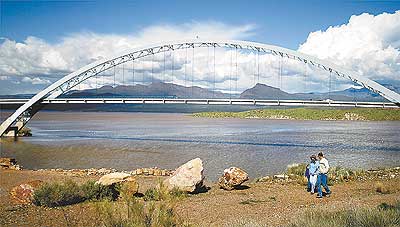
Roosevelt Lake will reach historic high levels today and likely will fill to capacity by spring, three years after the giant reservoir nearly dried up.
Runoff from a series of winter storms has more than doubled the lake's size in just 55 days. Water is now lapping up against never-before-used sections of Roosevelt Dam, which was expanded in 1996 just as a record nine-year drought began.
As a result, the Valley's water supply is in its best shape in more than a decade. Salt River Project, which manages Roosevelt and five other reservoirs, will head into the warm-weather months with a nearly full system for the first time since the early 1990s, allowing the utility to stop tapping backup wells. advertisement
Six Valley cities will reap extra benefits as runoff into Roosevelt fills new storage space created by the enlarged dam. Those cities - Phoenix, Mesa, Glendale, Scottsdale, Tempe and Chandler - helped pay for the dam's expansion in return for water from the reservoir's added capacity.
The rising lake is also good news for outdoor sports enthusiasts. Tonto National Forest already has reopened the popular Grapevine boat ramp, which had been closed the past seven years. Anglers say the nutrient-laden runoff will produce bumper crops of bass and crappie, conditions that should linger for several years.
It's a striking turnaround for Roosevelt, which had become the most visible symbol of Arizona's drought, and for SRP, which had been pushed to its limits by the persistent dry spell.
"Our reservoirs can turn around in a year," said Charlie Ester, manager of SRP's water resources operations. "Would I have guessed it would happen going into this season? No, I'd have said it will probably take a couple of years."
Although the full reservoirs let SRP end water rationing earlier this year, Ester said he's still not ready to declare an end to the drought. Heavy runoff won't erase nine years of below-average rain and snow, nor will it restore damage to the forests and rangelands, he said.
"There are a lot of effects of the drought that can't be erased in one year," he said, "things like groundwater levels and forest health." Storage also remains low in reservoirs on the Colorado River, the Valley's other critical water source.
Roosevelt's contents as of today - roughly 1.32 million acre-feet, or almost 81 percent of capacity - is historic because it's more water than the lake has ever held. SRP and the Bureau of Reclamation raised Roosevelt Dam by 77 feet in 1996, creating new space for storage, flood control and dam safety.
The lake has now begun to fill that new space, rising above its old capacity and, in the parlance of engineers, getting the concrete wet for the first time.
SRP has no doubts about the new structure, even though it's never been put to a real-life test. It was built to withstand the "probable maximum flood" - the worst flood conditions hydrologists could think of - as well as the "probable maximum earthquake."
"If you're going to build a dam above a metro area with 3 or 4 million people, you want to make sure it's a very safe dam," Ester said.
The new dam sections are made of structural concrete and envelop the old masonry construction of the original dam, which was considered an engineering feat at the time it was built.
Heavy runoff into Roosevelt temporarily halted work on the dam in 1993, damaging several temporary structures as well as the powerhouse at the dam's base.
"At the time, some of the weather forecasts and runoff projections predicted a storm that could have overtopped the dam," said Mike Clester, who was project engineer for SRP's dam modification program. "The reservoir rose, but it never jeopardized the rest of the dam. But we were probably one storm away from water going over the top."
The dam expanded Roosevelt's storage capacity by more than 2 million acre-feet, but SRP can use just 286,000 acre-feet. The rest of the added storage is set aside for flood control and dam safety. If runoff pushes lake levels beyond the approved storage capacity, SRP would have to release the excess water within 20 days.
Almost all the extra storage space was divided among the six Valley cities in return for their financial contributions. Phoenix will take half the water and the other five cities will divvy up the rest.
"It's something of a luxury right now, something we want to grow into," said Doug Kukino, environmental resources director for Glendale, which can claim 15 percent of the new storage space. The city likely will store some of the water in underground aquifers, shoring up long-term supplies.
"We see it as an asset," Kukino said. "We're trying to save water when we have water to save. We know there will be a time when we'll need to use it."
Roosevelt's rapid rise will carry environmental effects as well. Water has probably already inundated areas where the endangered Southwest willow flycatcher had made a home after the lake declined. SRP completed a conservation plan for the tiny bird last year, pledging millions of dollars to maintain habitat elsewhere.
Without that plan, SRP would have been forced to release water from Roosevelt before it reached the flycatcher nesting areas.
At the lake itself, the rising waters will give boaters access to ramps and launching areas that have been useless for years. Five boat ramps are now available: one at the Cholla Recreation Site on the Tonto Creek arm of the lake, one at Roosevelt Marina, two at the Windy Hill Recreation Site and the newly opened ramp at the Grapevine Recreation Site.
Fishing will be phenomenal this year and probably for several years to come, even if next winter isn't as wet as this one, said Rory Aikens, a spokesman for the Arizona Game and Fish Department. The heavy runoff is bringing extra nutrients and the rapid lake levels are inundating vegetation that will create new mini-habitats beneath the surface.
"When the water gets into the new lake area, it's going to become one of the best bass and crappie fisheries in the country," Aikens said. "It'll be a whole new era of fishing for Roosevelt Lake."
He said biologists expect to see "new-lake syndrome" because so much of the reservoir has been dry for so long. When Waddell Dam was expanded more than a decade ago, Lake Pleasant experienced the syndrome and helped anglers set records in fishing tournaments.
"This is going to be the start of the good old days that people will be talking about for 20 or 30 years," Aikens said.
Attached Image

|


 9-02-2026 Three Word Post.....The Next Generation.... (Rep.#20,276) from: GoFastRacer














 Well it never made it down here. We have the golf tourney and a huge rodeo in town this weekend. So it can take a break for a week or so.






 I hope those pics I lost arn't gone forever I had no backup on some of them
  Â